
Advanced Testing: The Key to Long-Life Marine Batteries
Author: Rafael Puig, R&D Manager, Power Solution, Terma
Marine battery systems are already powering vessels worldwide from ferries to cargo ships operating in emission-controlled zones. But the real challenge isn't just getting batteries on board; it's keeping them performing reliably for years in one of the harshest environments imaginable.
Understanding the Lifespan of Marine Batteries
Marine environments present unique operating conditions that differ significantly from those on land. Factors such as salt exposure, humidity, temperature changes, and vibration can influence how batteries perform over time. As a result, marine batteries often require more careful management to achieve optimal lifespan compared to those used in automotive settings, where conditions are generally more stable.
While these challenges are well understood, predicting long-term battery performance at sea remains an evolving area. Traditional testing methods provide useful insights, but real-world conditions can still introduce variables that are difficult to fully replicate in advance. This means that ongoing monitoring and proactive maintenance play an important role in ensuring reliability, minimizing downtime, and supporting compliance with emissions standards..
Electrochemical Impedance Spectroscopy: Predicting Battery Lifespan Before Deployment
This is where Electrochemical Impedance Spectroscopy (EIS) becomes critical. Instead of waiting years to see how a battery degrades, EIS analyzes internal resistance at different frequencies to predict long-term performance.
Here's what makes it powerful for marine applications:
Early degradation detection - EIS can identify subtle changes in battery chemistry that indicate premature aging, often months before traditional tests would catch the problem.
State-of-health monitoring - By measuring impedance regularly throughout a battery's life, operators can track degradation patterns and predict when replacement will be needed—avoiding unexpected failures.
Quality verification - Before a battery ever goes to sea, EIS testing ensures it's built to withstand the marine environment. At Terma, we integrated EIS into our Battery Cell Tester specifically because it lets us fast-forward through years of aging in a matter of hours.
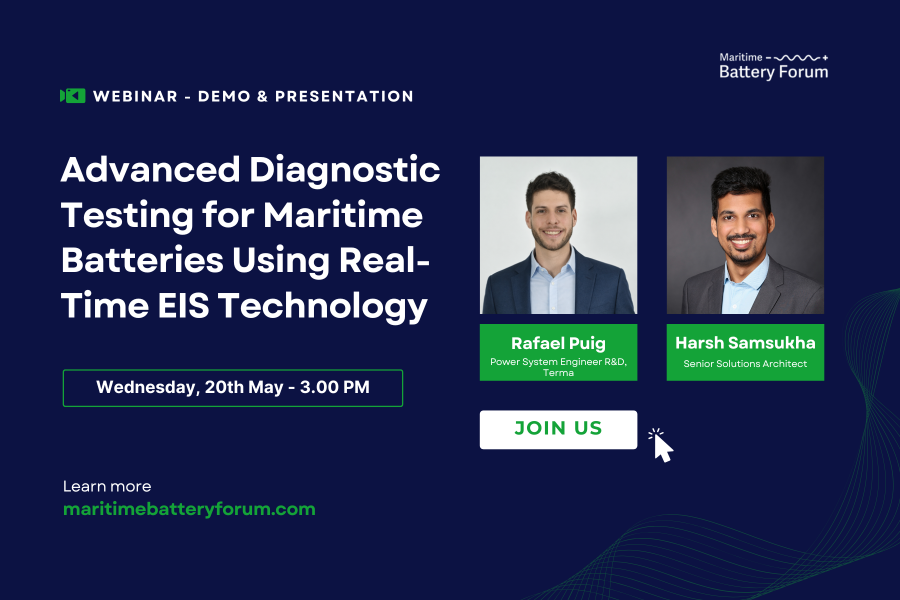
Rafael Puig, Power System Engineer R&D, Terma and Harsh Samsukha, Senior Solutions Architect, Safion will be discussing more on this in a webinar showcasing how real-time Electrochemical Impedance Spectroscopy (rapidEIS) can transform battery diagnostics in the maritime industry by featuring live demos of real use cases. Join us on Wednesday, 20 May 2026 at 3pm!
High Power Pulse Characterization: Testing for Real-World Stress
Marine batteries don't operate in steady-state conditions. One moment they're delivering massive power surges for propulsion, the next they're providing sustained loads for hotel systems. This constant cycling accelerates wear.
High Power Pulse Characterization (HPPC) simulates these real-world conditions by subjecting batteries to rapid charge-discharge cycles that mirror actual vessel operations. This reveals how batteries respond to:
· Sudden propulsion demands during maneuvering
· Sustained power delivery during port operations
· Rapid recharging between operational cycles
· Peak loads when multiple systems activate simultaneously
The data from HPPC testing helps engineers optimize battery management systems to minimize stress on cells, extending operational life by years.
Automation: The Missing Piece for Scalable Testing
Advanced testing methods like EIS and HPPC generate enormous amounts of data. Manual testing is too slow, too inconsistent, and too prone to human error when you're trying to validate battery systems for fleets of vessels.
At Terma, we learned that fully automated testing processes are essential. Automation enables:
· Consistent, repeatable results across thousands of test cycles
· Faster development cycles - getting validated batteries to market sooner
· Continuous monitoring of production batches to catch quality issues immediately
· Data-driven optimization that reveals exactly how design changes impact longevity
From Testing to Operational Longevity
The goal isn't just to test batteries. It's to use testing data to actively extend their operational life. This means:
Optimized charging profiles - Using HPPC data to program battery management systems that minimize stress during charging cycles.
Predictive maintenance - Implementing onboard EIS monitoring to schedule maintenance before failures occur, not after.
Thermal management - Understanding how temperature affects degradation and designing cooling systems accordingly.
Cycle management - Limiting depth of discharge and controlling charge rates based on real degradation data, not just manufacturer specifications.
The Bottom Line
E-ships are here. The technology works. But long-term reliability depends entirely on how well we understand battery behavior before and during deployment. Advanced testing methods like EIS and HPPC, combined with automated testing processes, are the difference between batteries that last 5 years versus 15 years at sea.
For marine operators, this isn't just about meeting today's emission requirements. It's about building battery systems that remain economically viable throughout their entire service life. The infrastructure investment is massive. The batteries need to last.
