
Member Spotlight: DOF
This month, we are proud to feature DOF as our Member of the Month! DOF Group ASA is a leading global provider of offshore and subsea solutions, combining a modern fleet of vessels with deep engineering, project, and operations capabilities. Founded in 1981 in Austevoll, Norway, DOF has grown into a multinational operator with a strong presence across energy, renewables, and marine sectors. Its vision is to be a trusted and leading partner in sustainable offshore energy utilization, guided by safety, integrity, teamwork, and excellence.
Today, DOF operates a fleet of 73 vessels, 63 of which it owns, including construction support vessels, anchor handling tugs, platform supply vessels, and subsea assets. This scale makes the company one of the most significant players in the offshore sector. The company is focused on reducing its environmental footprint while balancing sustainability goals with the financial realities of operating in a capital-intensive industry.
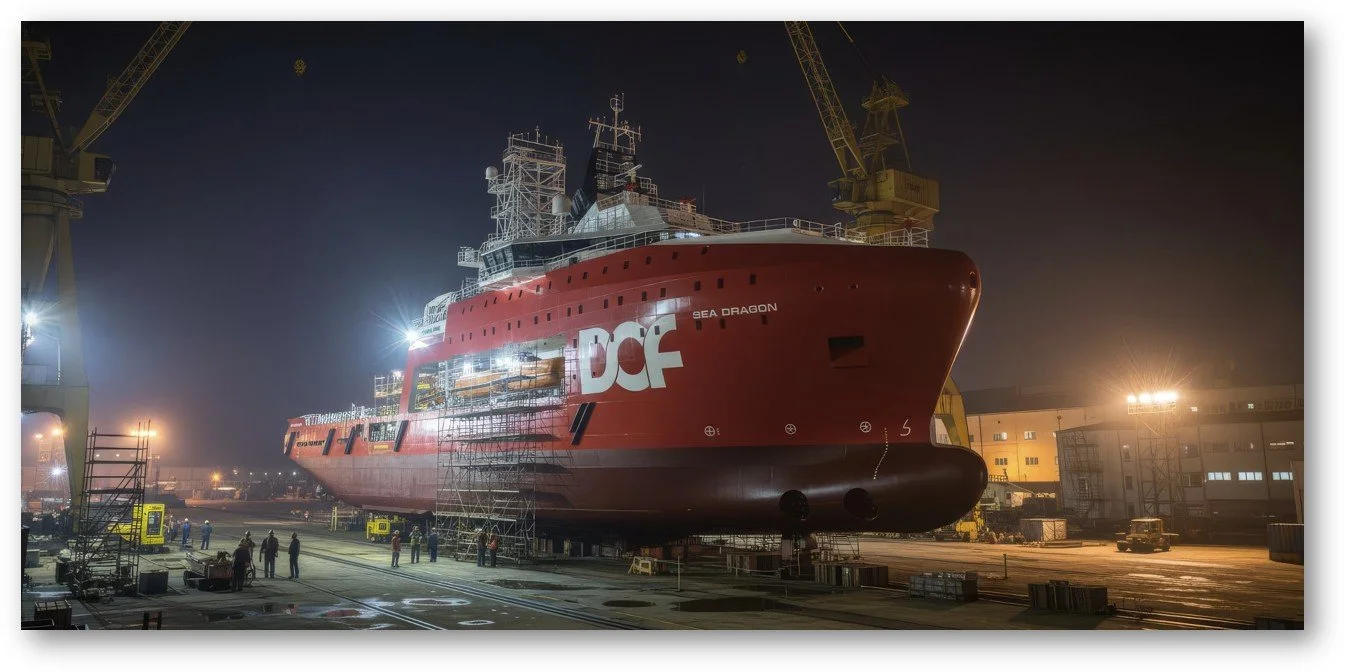
Ongoing Newbuild at Crist.Hull no 110. Purpose built FSV (Field Support Vessel) for Canadian Client Cenovous. Integrator Kongsberg Maritime with Corvus Energy Batteries
Fleet, Projects & Capabilities
DOF’s fleet is designed for demanding offshore operations such as inspection, repair & maintenance (IRM), subsea construction, and offshore wind support. Its capabilities extend from marine management and vessel operations to subsea project engineering and installation.
In renewable energy, DOF has built a strong track record in floating wind projects, such as Hywind Tampen, providing dynamic positioning, mooring, and installation expertise. Globally, it continues to secure large-scale contracts, including recent awards in North America worth more than USD 60 million, underlining both its competitiveness and its resilience in a challenging market.
Challenges in Marine Electrification
Speaking on behalf of DOF, Lars Christian Larsen, Global Energy Manager and former MBF board chair outlines both opportunities and hurdles in marine electrification. Costs remain a major barrier, with the difficulty of justifying upfront investments weighing heavily on vessel owners. The limited availability of shore power infrastructure globally further complicates the transition, especially for vessels working in remote or less-developed ports.
Battery technology itself also presents challenges. Current C-rates and energy density are not always sufficient for offshore vessels with high power demands, and integration adds complexity for operators and crews. Industry conservatism and the long lifespans of vessels, often 30 to 40 years mean adoption of new propulsion technologies can be slow. Despite this, Lars Christian has stated that all newbuilds from DOF are likely to incorporate battery systems, marking a clear commitment to electrification.
Complementing Other Power Sources
Lars Christian on the future of batteries sees it as “integral to the future of vessel design”, particularly in the offshore segment where energy recovery and hybridization can bring significant efficiency improvements. While batteries alone cannot meet the full demands of offshore operations, they will play a crucial role in complementing other power sources such as diesel, LNG and potentially ammonia if we reach a point of abondance of renewable energy through shore based Nuclear power. Hydrogen have shown to have little or no appetite among DOF’s clients. Hybrid architectures that combine these energy sources with battery storage will enable emission reductions, fuel savings, and operational flexibility.
Although adoption across the industry will likely remain gradual, Lars Christian believes that as battery technology improves in safety, energy density, and cost efficiency their role in offshore operations will grow. Batteries are expected to become central to vessel design for energy optimization, effective DP operations with less engines engaged , and integration with emerging green fuels. Going forward with newbuilds in offshore segments it would be necessary to ensure running DP operation with closed bus-tie. Therefore, it is likely that most new vessel will have DC switchboard to ensure CB notation to ensure clients acceptance for closed bus-tie operation.
Towards a Lower Emission Future
DOF’s combination of global reach, subsea engineering depth, and large fleet makes it uniquely placed to help lead the offshore industry toward a lower-emission future. By among other going far in committing to incorporate batteries into future newbuilds, exploring hybrid architectures, and aligning with the broader energy transition, DOF is taking practical steps to reduce its environmental impact while maintaining operational excellence.
As challenges around cost, infrastructure, and conservatism gradually ease, DOF’s proactive stance ensures it will remain at the forefront of sustainable offshore operations. But, let us never forget; Batteries are not an energy source, it is an energy storage enabler.
About the Maritime Battery Forum
The Maritime Battery Forum was founded with the aim of promoting new and efficient energy storage technologies in the maritime industry. With over 90 members across 3 continents, the MBF works to disseminate information, facilitate discussion, and accelerate the journey towards a zero-emission maritime future.
Contact :
Ayomide Miracle Salifu
Community & Communications Manager
Email: ayomidesalifu@maritimebatteryforum.com
Website: www.maritimebatteryforum.com
